In the first post we showed that the Muslim world's fertility collapse is real, record-fast, and almost entirely unreported: a median of 6.8 children per woman in 1963, down to 2.75 today, with fourteen countries now below replacement. That raises the obvious question — and for once, the data can answer it: why?
Ask around and you get the same list of suspects. Women went to work. Countries got rich. The young turned secular. Or maybe it was all the wars. Each of these is a real theory with real defenders. So we built a 53-country panel from 1950 to 2023 — fertility plus income, women's employment, girls' schooling, child survival, urbanization, contraception, battle deaths — and asked a simple question of each suspect: did you move before the crime, during it, or after?
01 — The timing testChild survival and cities led. Jobs and money followed.
For every country we found the year its fertility fall reached the halfway point, then did the same for each candidate driver. The lineup is unambiguous. Child mortality crossed its midpoint 12 years before fertility did — in 80% of countries. Urbanization led by 11. Meanwhile women's wage employment trailed by 12 years, and income per capita by 17.
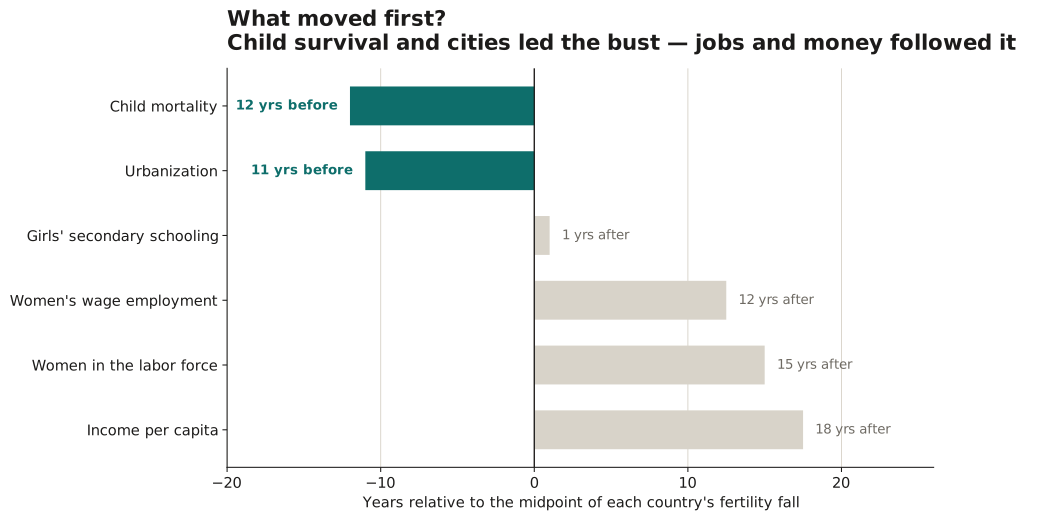
Read that again: the average Muslim-majority country was halfway through its fertility collapse nearly two decades before it got rich. Whatever caused the bust, it was not prosperity. The babies stopped before the money arrived — which quietly kills the "it's just oil wealth" story too.
02 — The schooling puzzleGirls' education works without a job at the end of it
Girls' secondary schooling is the strongest forward predictor of the next decade's fertility decline. So the obvious story is: education → jobs → fewer babies. Except the jobs never came. Iran fell from 4.6 children per woman in 1991 to 1.75 in 2010 while the share of working women in wage employment stayed perfectly flat at 50%. Saudi Arabia collapsed from 5.6 to 2.3 with its female employment structure unmoved.
The resolution is well known to demographers and invisible to economists: schooling works through the household, not the labor market. Literate mothers keep more children alive — so they stop "insuring" with extra births. They use contraception more, marry later, and bargain harder inside the family. Karen Oppenheim Mason called this the autonomy channel; John Caldwell's wealth-flows theory gives the deeper logic — the moment children go to school, they stop being farm assets and become expensive dependents. None of this requires a single woman to draw a salary.
The exception proves the rule. Bangladesh — the one country where female wage jobs (garments) genuinely boomed alongside the fall — is the one place researchers have shown factory jobs did delay marriage and raise girls' schooling. Jobs can be a driver. In most of the Muslim world, they just weren't there to be one.
03 — The attitude that actually movedWomen wanted smaller families long before they had them
If it's not jobs, is it values? Here the data gets subtle, and more interesting. Since the 1980s, DHS surveys have asked women a beautifully direct question: how many children would you ideally want? In the fast-transition countries, the answer was low long before behavior caught up. Pakistani women in 1991 wanted 4.1 children while having 6.3. Egyptian women in 1988 wanted 2.9 while having 4.8. Bangladeshi women in 1994 wanted 2.5 while having 3.7.
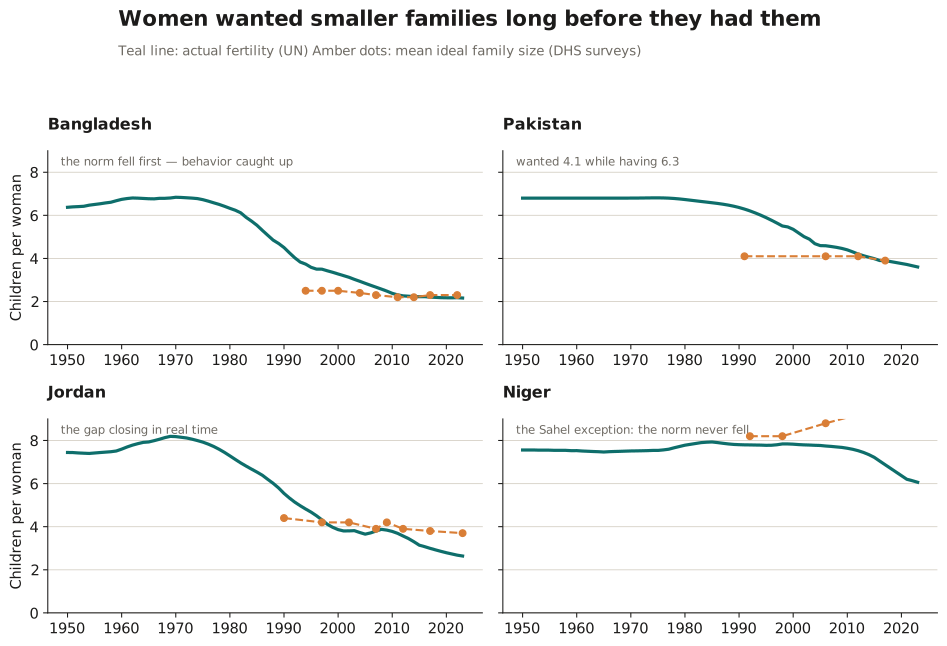
Then the behavior converged onto the want, survey by survey, like a stone settling. This is Richard Easterlin's supply-and-demand framework drawn from real numbers: the demand for children collapsed first; contraception and later marriage then closed the gap between the family women wanted and the one they were having.
But notice what kind of attitude this is. Not feminism. Not secularism. A family-size norm — quiet, domestic, and entirely compatible with a conservative society. Which brings us to the Sahel, where the norm never fell: Niger's ideal was 9.2 in 2012, Chad's around 8. High fertility there isn't blocked modernization. It's genuinely preferred. The two-speed Muslim world is a preference divide, and policy that doesn't respect that will fail.
04 — The suspects with alibisWar, wealth, and the secularization wave
Three popular theories failed the timing test outright.
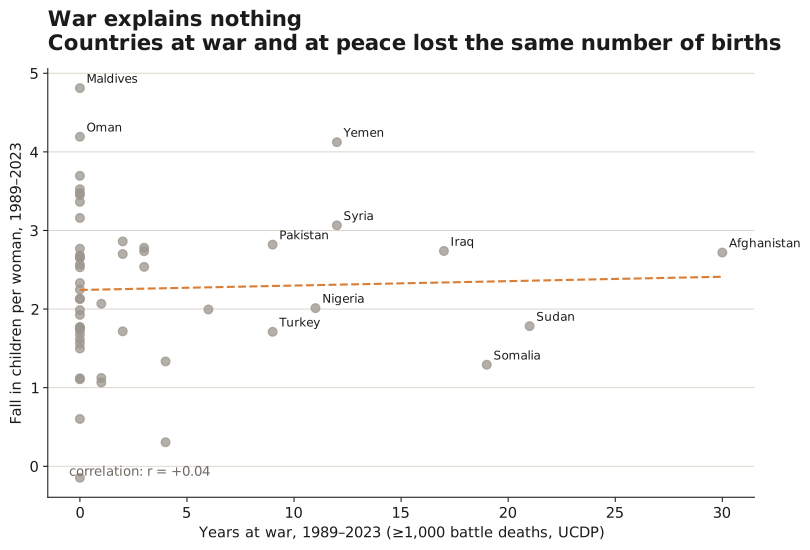
War. Conflict exposure and decline size correlate at r = +0.04 — nothing. Countries with years of war lost the same number of births as countries at peace (−2.07 vs −2.19). Syria suffered 72,000 battle deaths in 2013 alone; its fertility trend didn't even blink. The fastest falls happened in the Gulf, Iran, and the Maldives — places with zero war years.
Secularization. The famous Arab Barometer finding — the share of Arabs calling themselves "not religious" jumping from 8% in 2013 to 18% in 2019 — came decades after fertility turned. Then, in 2021–22, religiosity rebounded across the region (Morocco's "not religious" share fell 7 points). And fertility? It kept falling in all ten surveyed countries, right through the religious revival. Whatever secularization is doing, it is not steering the birth rate.
Money. Income growth does predict the next decade's decline — but the level of income lagged the fertility midpoint by 17 years. Countries didn't wait to get rich. They got fewer children while still poor, which is precisely what made the transition so fast.
05 — The verdictEighty years of theory, confirmed in one generation
None of this pattern is new to demographers — and that is the story. Mortality-first is the original transition theory (Notestein, 1940s). Schooling-as-trigger is Caldwell. Demand-before-behavior is Easterlin. A transition racing ahead of economic development is Cleland and Wilson's "ideational change," the same diffusion signature Coale found in 19th-century Europe. The Muslim world didn't break the theory. It ran the theory at double speed.
And where causal experiments exist, they rhyme with our panel. In Bangladesh's Matlab villages — a rare near-randomized trial — intensive family-planning and child-health services cut fertility 10–17% among poor, largely illiterate households. In Brazil, towns that received Rede Globo's TV signal (whose soap heroines were mostly childless) saw fertility drop — and parents started naming babies after the characters. In Iran, the 1989 family-planning program preceded the fastest voluntary decline ever recorded.
The causal chain, as best the evidence supports it: children stopped dying → families moved to cities → girls went to school, carrying a new picture of what a family is → wanted fertility collapsed → contraception and later marriage closed the gap. Money, jobs, secular values and war watched from the sidelines.
The fine print — read before quoting
- Timing is not causation. Our panel tests what moved in what order across ~50 countries; the experimental evidence cited (Matlab, Globo, Iran) is what justifies causal language, not our correlations.
- DHS covers 32 of our 53 countries — Iran, the Gulf, and Tunisia are missing from the ideal-family-size analysis; their story is inferred from neighbors.
- The 1990s TV channel is untested here — mobile/internet arrived too late to explain the turn, and historical TV-penetration series are no longer in the WDI. The telenovela mechanism rests on the Brazilian evidence, not ours.
- Domestic violence is untestable as a driver: DHS IPV modules are sparse and not comparable across years. We say so rather than fake it.
- Survey ideals are statements, not deeds — but that is the point of Fig. 2: the statement moved first.
The first post showed the bust. This one showed the engine: not wealth, not war, not a values revolution — but children living, cities growing, and girls reading. The next question is what a region looks like when it ages before it gets rich. That is where the numbers get uncomfortable.