Ibn Khaldun had a theory of political death. States, he argued in the Muqaddimah, are born on asabiyya — the solidarity of a tribe, a sect, a conquering band. The founder is strong; his son remembers; his grandson enjoys; the fourth generation squanders. By then the asabiyya is spent, and the dynasty falls. Three generations. Call it 120 years.
It is a beautiful theory. It is also, until now, untested at scale. Historians quote Khaldun the way economists quote proverbs. So we coded 85 Muslim dynasties from 632 to today — every caliphate, sultanate, khanate and emirate we could date, plus a control group of 20 non-Muslim dynasties — and ran them through survival analysis, the statistical machinery doctors use to ask how long patients live.
Here is what 650 years of hindsight says about the most famous law in Islamic historiography.
01 — The testKhaldun nailed the mode and missed the wall
The most common fate of a Muslim dynasty is to die at almost exactly the age Khaldun predicted: the lifespan histogram peaks right at 100–150 years. But look at the survival curve — the probability that a dynasty is still standing N years after founding. At Khaldun's 120-year mark, 70% of dynasties are still alive. The median dynasty lives 157 years, a full generation longer than the law allows.
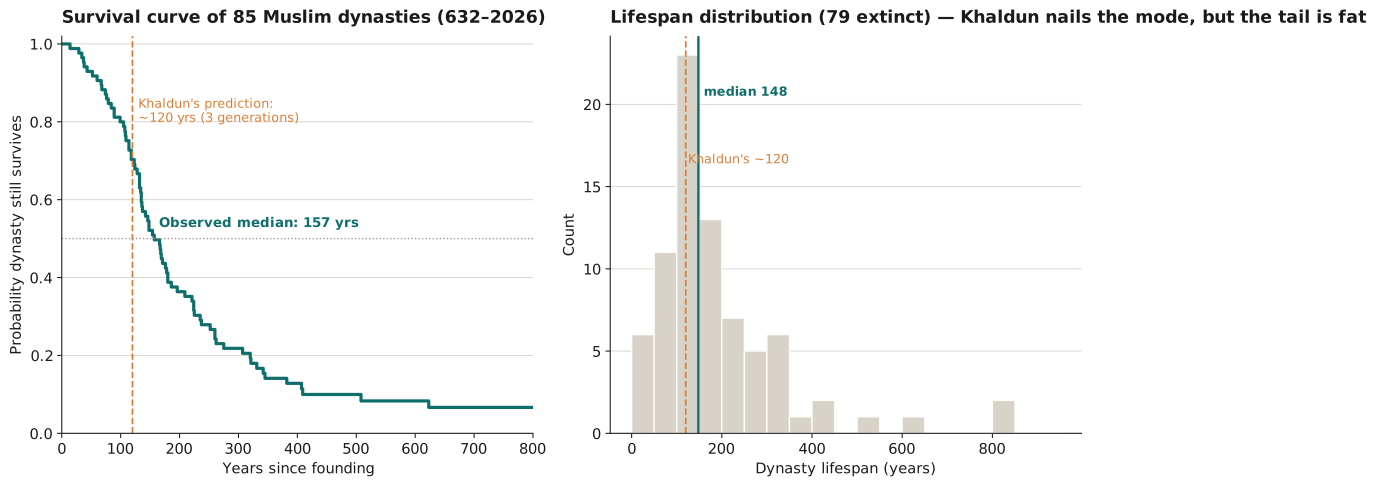
So the "law" is wrong as a deadline — most dynasties blow straight through year 120. But it is eerily right as a center of gravity. And the distribution has a fat tail: a meaningful minority — one dynasty in four — passes 250 years. Something lets some states escape the law entirely. We'll come back to them.
02 — The comparisonMuslim dynasties die faster — and it's the movements that burn fastest
Against a control group of 20 European and Asian dynasties — Capetians, Habsburgs, Romanovs, Tang, Ming, Qing — the Muslim record looks brutal: median 157 years against 270. Muslim dynasties die at nearly twice the rate.
Why? The strongest candidate is succession. Christian Europe settled (mostly) on primogeniture: the eldest son inherits, everyone else stands down. Classical Islamic political culture never did. Every succession was a fresh contest among brothers, uncles and cousins — and each contest was an opportunity for a frontier governor or slave-soldier to found something new. The Ottoman escape from the law begins the day succession gets ritualized — first by fratricide, then by the cage.
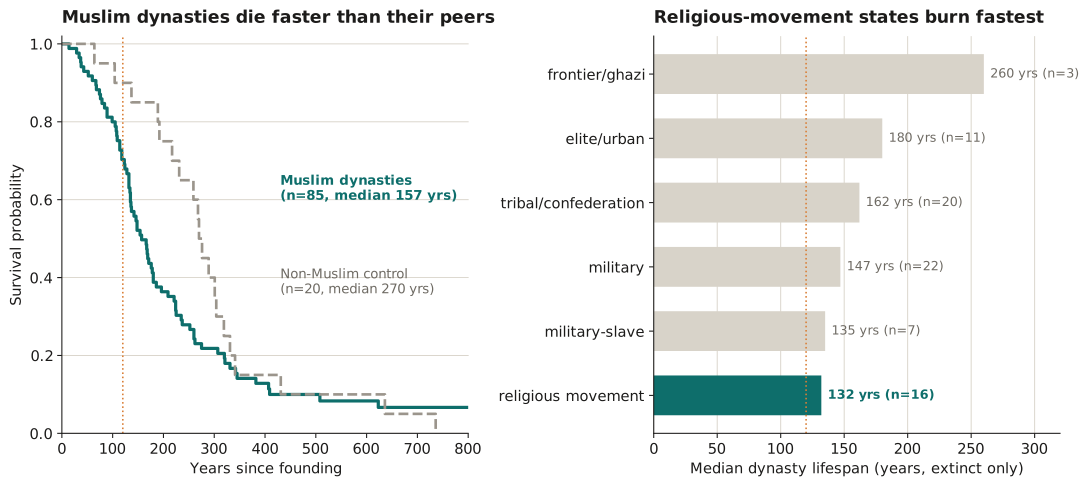
And inside the Muslim world, Khaldun's own mechanism shows up in the data. Dynasties founded by religious movements — the Fatimids, Almohads, Safavids, Sokoto, the Mahdiyya — die youngest of all, median 132 years. The purest asabiyya burns brightest and fastest: a movement fused with a state inherits the state's enemies and loses the movement's flexibility. Military usurpers do better (147). Tribal confederations better still (162). The longest-lived founders are the unglamorous ones: urban elites and sharifs (180), and frontier march-lords (260) — though the ghazi count is small, and one of the three is the Ottomans, which flatters the average.
03 — The real shape of political deathDynasties don't age. They decay.
Khaldun imagined a life cycle: youth, maturity, senility — a wall at the third generation. If he were right, the death rate should spike around years 100–140. It doesn't. The hazard curve is roughly flat from middle age onward: a dynasty that has survived 300 years is in about as much danger this decade as a dynasty that has survived 100.
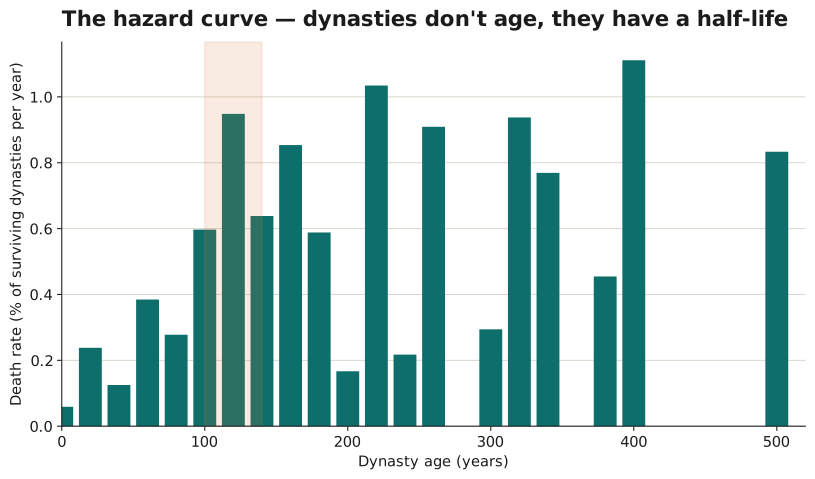
In other words: dynasties have a half-life, not a lifespan. Each year in power rolls the same dice — succession crisis, fiscal squeeze, frontier revolt — and survival compounds. That reframes the question Khaldun asked. The puzzle was never "why do dynasties die at 120?" Most don't. The puzzle is the escapees: the Ottomans (623 years) and Kanem-Bornu (818). What they shared was not stronger founders but better institutionalized succession — rules for the one moment that kills states.
04 — The modern echoWhere the Al Saud stand
The obvious modern application is Saudi Arabia. Date the state from the 1932 proclamation and it is 94 years old; date it from Abdulaziz's 1902 capture of Riyadh and it is 124 — squarely past Khaldun's wall, in the flat middle of the hazard curve. Its founder type (military conquest: median 147) says actuarially ordinary. Its survival strategy says otherwise: the Saudi answer to Khaldun has been relentless succession management — the Allegiance Council, the lateral brother-to-brother inheritance, the deliberate manufacture of predictability — plus an oil rent that smothers fiscal crisis, the second great killer.
The Muqaddimah's deepest claim was that no state escapes the cycle. The data suggest a correction: states don't escape by being strong. They escape by making the succession boring. Watch the boring institutions.
The fine print — read before quoting
- The dataset is hand-coded history. 85 dynasties with documented start/end dates and confidence grades (A: ±2 yrs, B: conventional dates, C: uncertain — two rows flagged, including Kanem-Bornu's start). Coding boundary rules matter: the Delhi Sultanate counts as one state across five dynasties; the Abbasid shadow caliphate in Cairo is excluded; the three Saudi states are separate rows.
- The control group is small (n=20) and European/Chinese-heavy. The 157-vs-270 gap is suggestive, not definitive — expanding the control group is the project's stated next step.
- Survivorship bias runs both ways: recorded dynasties are the ones notable enough to be chronicled; hundreds of petty emirates died unrecorded.
- Survival analysis handles the living honestly — the six ongoing dynasties (Morocco, Jordan, Saudi, Oman, Johor, Brunei) are right-censored at 2026, not treated as dead.
- Founder types are judgments, coded against standard chronologies (Bosworth's New Islamic Dynasties as the reference spine). Reasonable coders would differ on a handful of rows.
Khaldun wrote the Muqaddimah while North Africa collapsed around him — dynasties falling fast enough to give him a sample. He read the pattern better than anyone before the invention of statistics had a right to. The mode, the mechanism, the role of solidarity — all confirmed. Only the wall was wrong. There is no wall. There is a half-life, and a short list of states that learned to make successions dull.