Every year the world's countries are ranked: GDP, HDI, competitiveness, happiness. Every ranking bakes in a philosophy of what a good society is — and it's never an Islamic one. But Islamic legal theory has had its own answer for six centuries: the maqasid al-sharia, the "higher objectives" that al-Shatibi systematized in the 14th century. A just order, the tradition says, protects five things: life, intellect, religion, progeny, and property.
So we built it. The Maqasid Index scores 216 countries, 0–100 per pillar, from measurable outcomes: longevity and safety for life; schooling for intellect; birth attendance and child nutrition for progeny; income and poverty for property. Religion — the hardest to measure honestly — is discussed below but not scored in this first version. Then we asked the only question that matters: how does the Muslim world do on its own exam?
01 — The profileOne win, three deficits
The median Muslim-majority country scores 81.4 — just under the rest of the world's 83.8. But the average hides the shape of it. On life, the region leads: 88.4 against 84.8. On intellect (70.3 vs 79.0), progeny (84.8 vs 92.7) and property (78.4 vs 87.9), it trails.
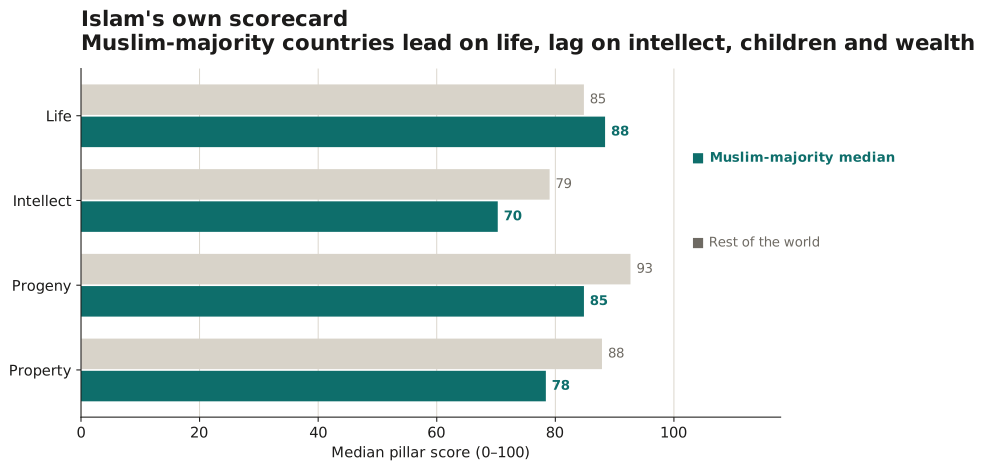
There is a pleasing irony available here: the one pillar the region wins is the one that requires protecting people from each other — and it wins it decisively (more below). The pillars it loses are the ones that require building things: universities, well-fed children, broad prosperity.
02 — The win, examinedA floor, not a ceiling
Break the life pillar into its parts and the victory gets specific. It is entirely a safety victory: on homicide, Muslim-majority countries hold 7 of the world's top-10 spots (score 96.9 vs 89.8 elsewhere). On longevity and child survival, the region actually lags — 81 vs 83 and 86 vs 91.
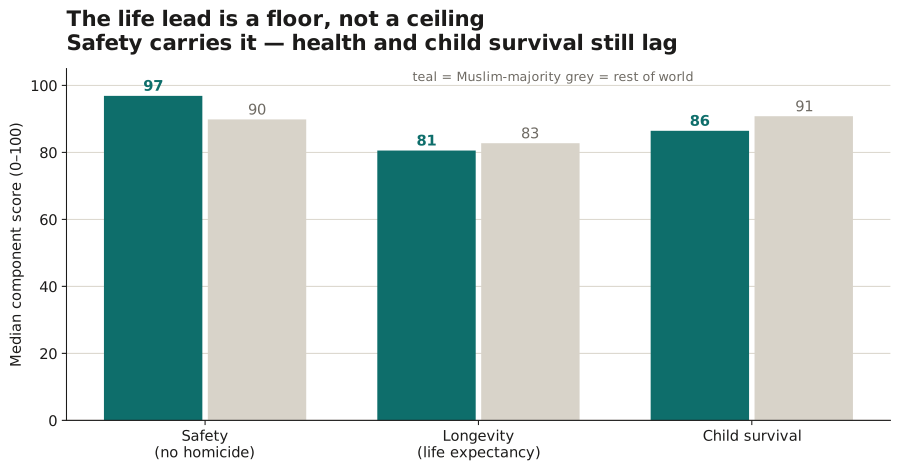
So the lead is a high floor, not a high ceiling. The Muslim world doesn't produce the longest-lived societies — the life-pillar top ten is Japan, Singapore, Spain, Korea — but it produces the fewest societies where people kill each other. We saw the same finding from the street level in Safe Streets, Unsafe Homes; it holds at the level of classical Islamic ethics too. Hifz al-nafs, the protection of life, is the maqsad the tradition lists first — and it is the one the data says the region actually performs.
03 — The tableThree countries break the top 30
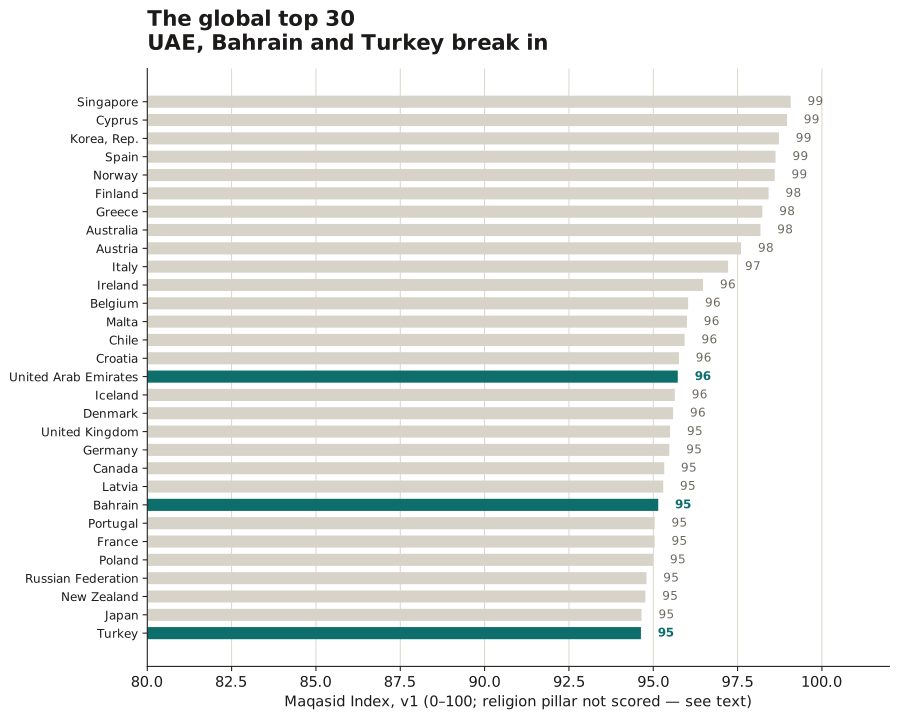
The overall index is dominated, as every such index is, by rich small states — Singapore, Cyprus, Korea, Spain, Norway. But three Muslim-majority countries break in: the UAE at #16, Bahrain at #23, and Turkey at #30, with Kuwait, Saudi Arabia, Albania, Qatar and Brunei just behind.
The deficits have precise addresses. The intellect gap is a university gap — secondary enrollment has nearly closed (88 vs 93), but tertiary enrollment is 39.8 against 55.0. And the progeny gap is a children's gap: stunting is mediocre on both sides, but birth attendance and child survival lag. A civilization that teaches that protecting intellect and progeny are among the five purposes of its law is under-delivering on exactly those two.
04 — The missing pillarWhy religion isn't scored
Honesty requires a confession: we left out the maqsad of religion — hifz al-din. Not because it's optional, but because measuring "protection of religion" well requires country-level religious-freedom data (Pew's GRI/SHI), which is not machine-readable in its current published form. There's precedent: the famous Islamicity Index of Askari and Rehman made the same call, noting that including religion would confuse "living by Islam" with "being Muslim." We score what's measurable and say so. A v2 with the fifth pillar is planned.
The fine print — read before quoting
- Index design is philosophy with arithmetic. Goalposts (e.g. life expectancy 20–85) and equal weights are judgment calls; the README and code document every one. Rankings move a little if you change them; the profile (safety up, intellect/children/wealth down) is robust to reasonable changes.
- Latest-year mixing. Each country is scored on its latest 2015–2023 reading; vintages differ.
- Coverage. 216 of 264 WDI entities are fully scored; 44 Muslim-majority. Data-poor countries drop out — which itself correlates with the deficits.
- The index measures outcomes, not piety. A high score doesn't make a country "Islamic" and a low one doesn't make it "un-Islamic" — the maqasid are ends any society can serve, which is the point.
- Religion pillar: excluded in v1 (see above); Pew GRI/SHI would change Muslim-country scores — likely downward on religious freedom, which is exactly why a v2 needs it.
The exercise inverts the usual posture. Instead of measuring the Muslim world by imported yardsticks and finding it wanting, we measured everyone by Islam's own ends — and found a region that protects life better than anyone and falls short exactly where its own tradition says learning and children matter most. The tradition, it turns out, is a demanding grader.