Ask a Western audience to picture violence in the Muslim world and they will picture a war zone. That is a headline image, not a lived one. The question worth asking is not where wars are fought — it is where people are actually hurt. So we assembled the everyday-violence record: homicide, assault, robbery, how safe people feel walking home at night, and what happens behind closed doors. 246 countries. The pattern is not the one the headlines suggest.
01 — The streetsThe safest streets on Earth
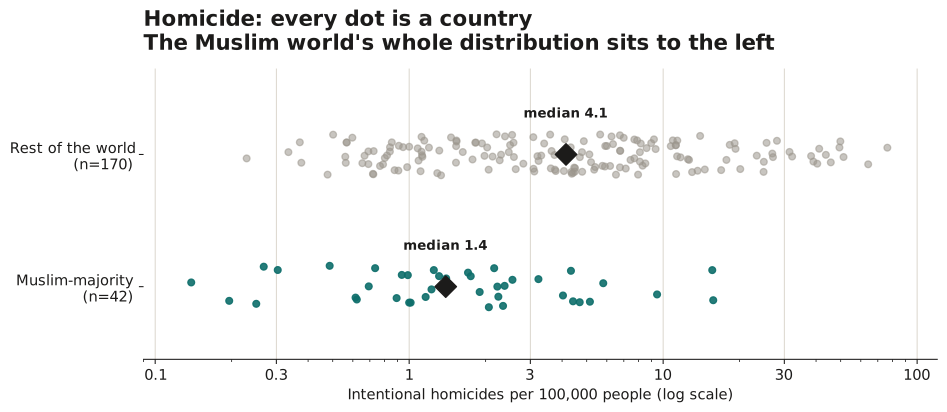
Start with the ultimate everyday-violence measure: homicide. The median Muslim-majority country records 1.4 killings per 100,000 people per year. The median everywhere else: 4.1 — three times as high. This is not an average dragged down by a few Gulf states; the whole distribution sits to the left.
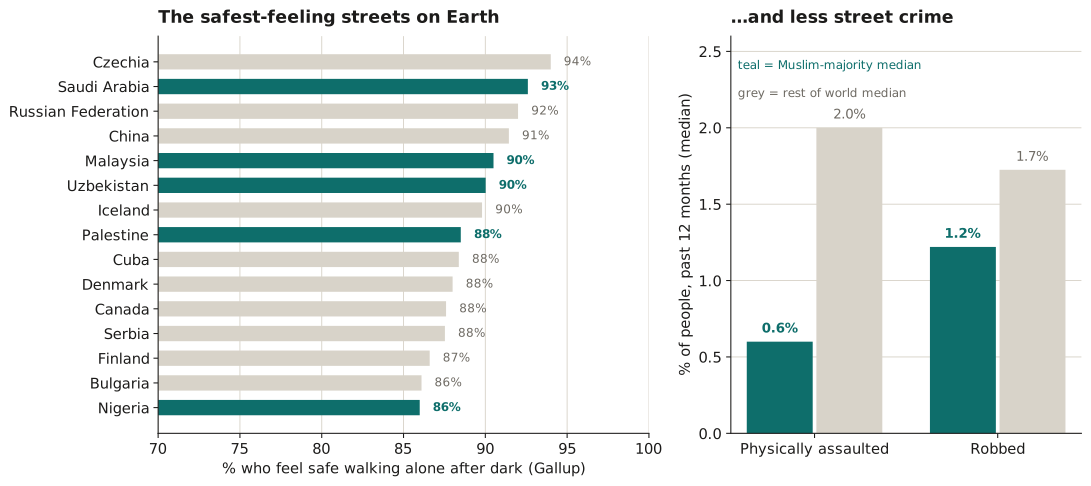
People's own experience matches the police data. When Gallup asks whether you feel safe walking alone after dark, the global top of the table is not Scandinavia — it is Saudi Arabia at 92.6%, with Malaysia, Uzbekistan and Palestine all in the top ten. And the victimization surveys agree: the median Muslim-majority country records a third of the physical assaults (0.6% vs 2.0% of people attacked in the past year) and noticeably fewer robberies (1.2% vs 1.7%).
Why? Three candidate explanations, honestly labeled as such. Alcohol: the strongest single correlate of homicide in the criminology literature, and largely absent from public life in most of these countries. Social control: dense family and neighborhood structures leave fewer dark, anonymous spaces — the same closeness Western critics call oppressive is also what watches the street. And inequality of a particular kind: the region's cities urbanized without producing the abandoned, disorganized peripheries that drive violence in Latin America. Each is a hypothesis; the data can say that the streets are safe, not yet why.
02 — The homesThe counterweight the headlines never mention
Now the part of the dataset that cuts the other way. The same WHO/UN estimates that measure violence between strangers also measure violence between partners. Across 32 Muslim-majority countries, the median share of ever-partnered women who have experienced physical or sexual violence from a partner is 12.6% — half again the rest-of-world median of 8.5%.
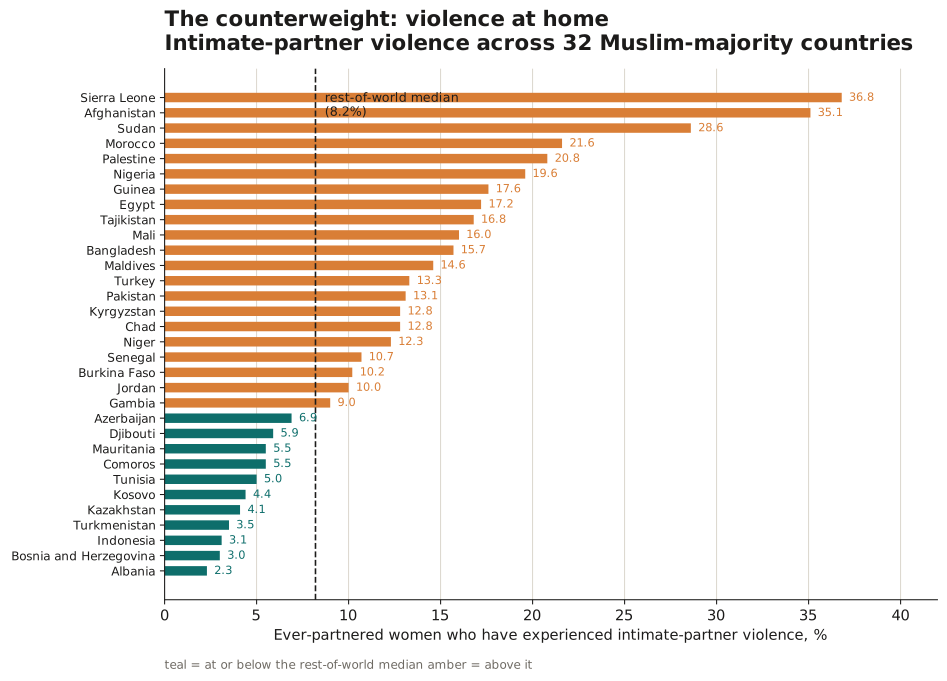
Two honest readings sit inside this chart. First, the range is enormous — Albania at 2.3% looks like Austria; Sierra Leone at 36.8% looks like a crisis — so "the Muslim world" is the wrong unit; the same two-speed split we found in fertility runs through violence too. Second, the countries with the lowest IPV are exactly the ones where women's secondary schooling arrived earliest and deepest — the Balkans, Central Asia, Indonesia. Which sounds familiar: the same variable that led the baby bust is the best predictor here too.
03 — What this meansUpdate the risk map
The policy version: the region's safety conversation is miscast. The data point to enforcement capacity that already exists — the question is whether it will be turned toward the home: shelters, reporting channels that women actually use, and the schooling that predicts the low end of Fig. 3. And the media version: a Muslim woman in Kuala Lumpur or Tashkent walks home safer than one in Paris or Houston, and no one will ever tell her so on the evening news.
The fine print — read before quoting
- Underreporting biases the Muslim side down. Victimization surveys in conservative societies likely miss more incidents — so treat the assault and robbery gaps as lower bounds, not exact differences.
- Coverage is thin. Assault data exists for only 15 Muslim-majority countries, robbery for 13, feel-safe for 19. The sexual-assault series covers just 3 and was excluded entirely.
- IPV figures are modeled estimates (WHO/UN Women), not raw survey reads; methods harmonize across countries, which can smooth real differences.
- War is deliberately out of scope. This post measures everyday interpersonal violence; conflict deaths are a separate question with separate data (and a separate post).
- Safety perception ≠ safety. Gallup's feel-safe question measures both; we read it as lived experience, not as a crime count.
The most mismeasured region on Earth is mismeasured in both directions here. The streets are far safer than the story. The homes are less safe than the silence. A serious conversation about violence in the Muslim world would start with the second sentence — and it would have to give up the comfort of the first.